Pay Transparency in Cyprus:
The law isn’t in force yet.
Your pay data already is.
Cyprus missed the EU
transposition deadline…
The part you can still
change is the short part
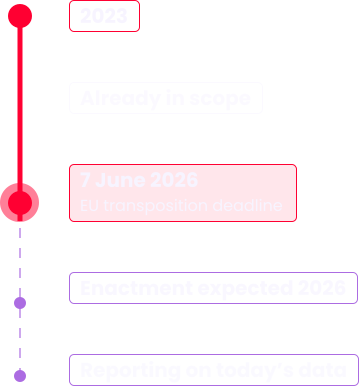


Cyprus missed the EU
transposition deadline…
The part you can still
change is the short part

*Verified 22 September. We update this section as the position changes.
Equal pay for equal work or work of equal value: Employers must ensure that women and men receive equal pay for the same work or work assessed as being of equal value, based on objective, gender-neutral criteria.
Pre-employment transparency: Employers must provide starting salary ranges to job applicants before interviews.
Right to information: Current employees can request information on their individual pay level and average pay levels broken down by gender.
Mandatory reporting: Companies with 100+ employees must publicly report their gender pay gap.
Personal liability: Under the draft, directors face criminal liability, including fines of up to €10,000 and up to six months’ imprisonment.
Joint Pay Assessment: If the reported pay gap exceeds 5% and cannot be objectively justified, employers must conduct a formal assessment with workers’ representatives.

Most organisations focus on the pay gap report. It is the last step. A gap figure means nothing until you can defend the job categories it is calculated across.
1.
Job architecture and job evaluation
Map every role to a defensible structure using objective, gender-neutral criteria, weighted as the Cyprus draft requires. Everything downstream depends on it.
2.
Pay structure and equal value analysis
Build or review salary ranges against job architecture. Identify differences with documented business reasons versus ones without.
3.
Data readiness
Establish whether systems can produce what the Monitoring Body will ask for, within the deadline. Fix gaps before the request arrives.
4.
Process alignment
Recruitment, performance, promotion and pay review must tell one consistent story. Where they contradict, it becomes evidence.
5.
Manager readiness
Equip line managers to explain pay decisions, handle challenge, and stay consistent. Where compliance becomes trust or a retention problem.
6.
Governance and documentation
Board-level clarity on accountability, decisions and their rationale, supported by clear procedures and a decision matrix. Given the draft personal liability provisions, this is no longer merely an administrative matter.
You may not need all six. Most organisations need two or three, and need to be told honestly which ones.

Readiness call
(30 minutes, no charge)
We establish size, structure, jurisdictions, data maturity and what is actually keeping you awake. You leave knowing whether
you have a problem and roughly how big it is. If you do not need us, we will say so.
Readiness review
A structured assessment against the Cyprus draft requirements, delivered as a findings report with a prioritised action plan. Written for a board, not for a filing cabinet.
Implementation
Job architecture, pay structure, data, process, manager capability. Scoped to what you need, sequenced so that each stage makes the next one possible.
Sustaining it
Reporting cycles, annual employee notifications, new-hire consistency, and the discipline to keep the structure defensible once the consultants have gone.

Connected to the European pay transparency landscape
The only Cyprus-based agency that is a member of the European Pay Transparency Alliance and an official Sysarb partner. Through active collaboration with partners across Europe, we stay informed about global market developments and see how job evaluation and reporting work in countries already applying the legislation – not only through the text of the Directive.
Trained on the tool the Cyprus regulator built
We are trained on eValueJobs, the digital tool developed by the Cyprus Ministry of Labour. Knowing exactly how the regulator weights skills, effort and working conditions is a preview of the standard your pay structure will be measured against.
Grounded in Cyprus, not imported
International frameworks fail when they ignore local employment law and pay practices. With decades of practical experience in international organisations based in Cyprus, we understand the realities and challenges of local employment law and pay practices. We know the details, bottlenecks and hidden implementation risks first-hand – not just in theory.
Compliance that doesn’t cost you the culture
A pay structure that is legally defensible but quietly resented is a failure. Transparency is an employee experience event before it is a reporting event. We treat manager readiness as core scope, not an optional add-on.

Legal compliance is the foundation, not the finish line.
Greece adopted Law 5316/2026 on 6 July 2026, with substantive obligations starting 1 November 2026. Cyprus has not yet enacted. That creates three practical problems for anyone with people in both countries.
Different clocks.
Your Greek entity has a hard date this autumn. Your Cyprus entity does not yet. A single group-wide programme timed to Cyprus will leave Greece exposed.
Different enforcement architecture.
Greece uses the Greek Ombudsperson and a dedicated Labour Inspectorate. The Cyprus draft routes reporting to the Department of Labour Relations. Two authorities, two sets of expectations.
Different detail, same Directive.
Greece has expressly recognised intersectional discrimination. The Cyprus draft requires explicit weighting of job evaluation criteria and carries a four-year data look-back. Materially different obligations.
A group pay structure built to the Directive’s minimum will satisfy neither properly. The work is to build one architecture that is defensible in both, and then handle the jurisdiction-specific requirements on top of it.